Cleaning windows streak-free sounds simple — until you step back two metres and see parallel lines running across the glass in the light. Professional window cleaning lasts 3–4x longer than DIY, and today we break down why through four factors: water, product, tool, and technique.
Factor 1: water
The main cause of streaks is hard tap water. After it dries it leaves calcium and magnesium salts visible as a fine mesh of whitish spots.
What to use:
- Demineralized water (sold for car batteries and irons)
- Rainwater if you have somewhere to collect it
- Reverse osmosis water if your kitchen filter has it
As a last resort — boiled tap water rested for 24 hours. Pour off the top, leave the sediment.
Pro cleaners in Tashkent bring demineralized water in a canister. It's the cheapest part of the kit but gives the most visible result.
Factor 2: the product
The rule: no ammonia. Ammonia is the base of most household glass cleaners. It:
- Reacts with the protective film on tinted windows and leaves haze
- Erodes the rubber seals on sashes over time
- Has a strong smell that irritates the airways
What to use:
- Pro glass concentrate based on isopropyl alcohol (Karcher, Pro-Brite, Tana)
- Soap solution — 1 tsp of liquid soap per litre of water — if nothing else
- Vinegar solution (1:10 with water) — for an occasional deep clean, not routine use
Avoid: aerosol sprays. They leave a thin polymer film that the next dust settles onto twice as fast.
Factor 3: the tool
At home people use a cloth and newspaper. Pros use three tools:
Squeegee
A rubber blade on a handle. Lifts water off the glass in one stroke, with no cloth contact. 30,000–80,000 sum, lasts for years. This is the key tool that turns amateur cleaning into pro work.
Microfiber wash mitt
Applies the solution to the glass. No lint, easy to wash and dry. Use a separate "clean" side for the final wipe of the frame.
320 g/m² microfiber cloths
For final polish and catching drips in corners. Know the difference: glass-cloths (soft, lint-free) vs. all-purpose (rougher). Glass-cloths cost more but earn it back in quality.
Don't use newspaper. It leaves printing ink on the plastic profile — you'll see it in a year.
Factor 4: stroke technique
The most common mistake: circular motions. They smear grime evenly and dry as a mesh of streaks.
The right way — one direction:
- Wet the glass top to bottom with the mitt, don't be stingy — the glass should be wet
- Pass the squeegee top to bottom in vertical strokes, overlapping each pass by 2–3 cm
- After every pass wipe the squeegee blade with a dry microfiber
- Catch corner and edge drips with a dry microfiber cloth
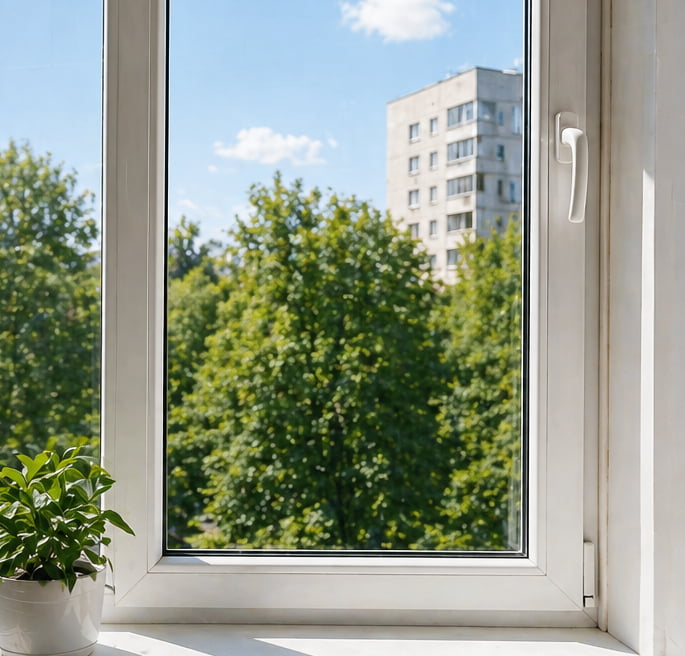
Final check: step back 2 metres, look at the window at a 30° angle to the light. Anything you missed shows immediately.
The right sequence
So you don't redo work:
- Take down curtains and blinds — otherwise they collect spray
- Move plants and items off the sill
- Cover the sill with film or an old towel — there will be water
- Remove the mosquito screen for separate washing
- Start with frames and sashes — vacuum the grooves, then damp cloth
- Outside glass
- Inside glass
- Mosquito screen — under the shower or garden hose
- Sill and drip caps
Inside is washed after outside — otherwise outside spray will leave streaks on the inside.
When to clean and when not to
Best conditions:
- Cloudy or evening — sun dries the solution faster than you can squeegee it
- Temperature +10 to +25 °C
- Calm or light wind
Don't clean:
- In direct sun — streaks guaranteed
- Below +5 °C — water crystallizes
- In rain (obviously)
- Above +30 °C — solution evaporates in 30 seconds
In Tashkent the best windows are early March, early May (before the heat), September–October.
What about panoramic windows
Big fixed floor-to-ceiling panes are cleaned from both sides with a squeegee on a telescopic pole. Outside above the 2nd floor — only industrial climbing. Don't try it yourself: there's no built-in tie-off, and balconies in most Tashkent buildings aren't designed for anchoring.
For houses, cottages, or apartments with lots of windows it's simpler to book a pro cleaning — 30,000 sum for a standard window, 50,000 for a double-sash.
Cheat sheet
- Demineralized water + ammonia-free product
- Squeegee — non-negotiable
- Microfiber, not newspaper
- Top to bottom, one direction
- Glass wet, squeegee dry after every pass
- Not in sun, not in frost
- Final check — at 30° to the light